Academic Commission of Academicians | aca.edu.ge
Academic CV & Dossier Center
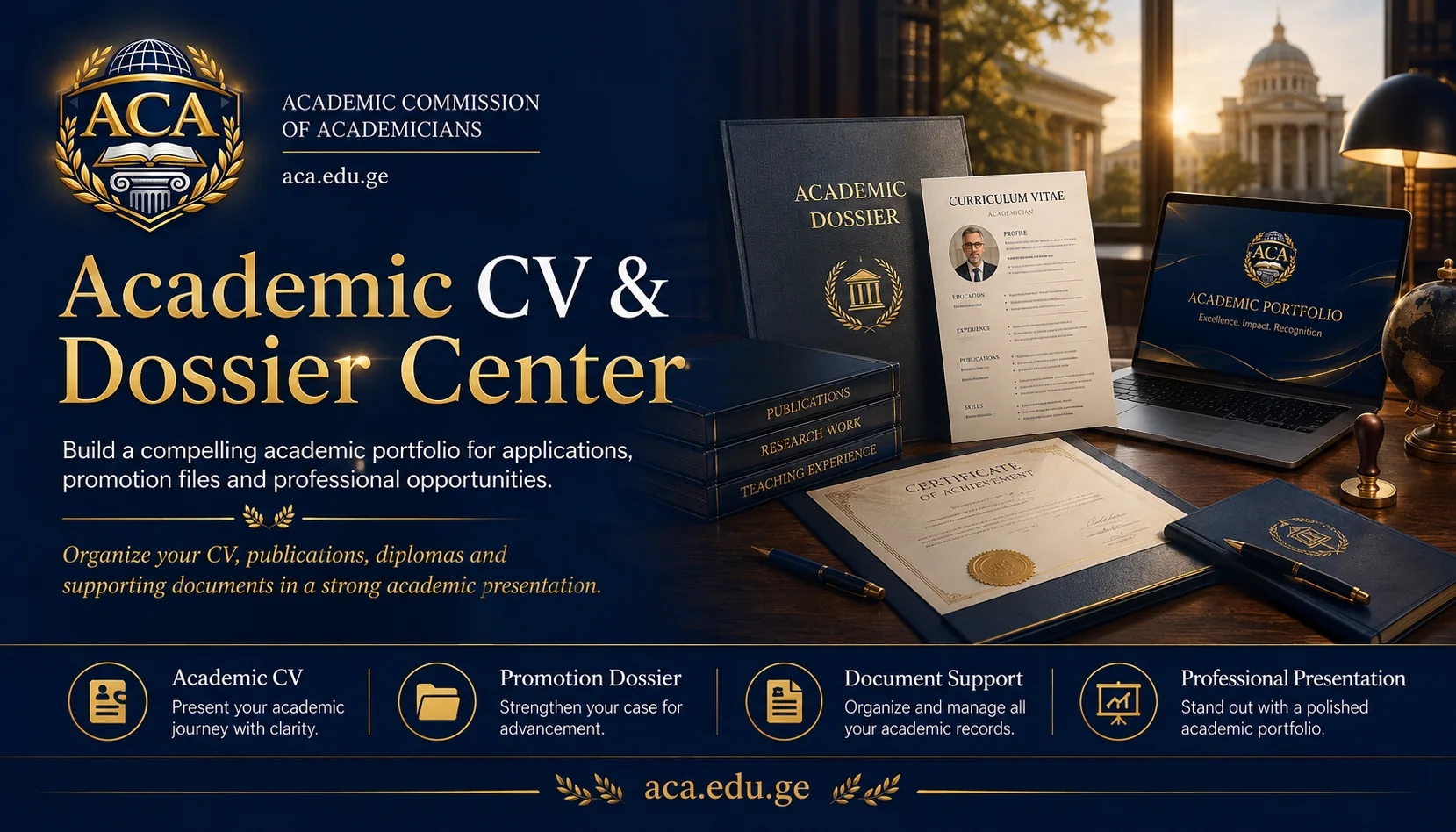
The Academic CV & Dossier Center helps members turn scattered academic history into a professional record. A strong dossier allows reviewers to see what the candidate studied, taught, researched, published, led and contributed without searching through unrelated files.
What this area helps you build
Practical academic development is easier when the work is divided into clear, reviewable components.
Academic CV architecture covering education, appointments, teaching, publications, research, presentations, supervision, service, leadership, awards and professional activity.
Publication documentation that clearly separates published, accepted, submitted and in-preparation work and includes DOI or stable links where appropriate.
Supporting evidence management for diplomas, certificates, appointment letters, teaching records, projects and other materials relevant to the intended review.
Professional dossier design that combines a concise academic narrative with the CV and selected evidence rather than presenting an unstructured document dump.
Detailed academic guidance for Academic CV & Dossier Center
This page is designed to be used as a working academic reference, not only as a short introduction.
The practical value of Academic CV & Dossier Center comes from connecting the immediate objective with the wider academic record. The Academic CV & Dossier Center helps members turn scattered academic history into a professional record. A strong dossier allows reviewers to see what the candidate studied, taught, researched, published, led and contributed without searching through unrelated files. ACA therefore encourages members to treat this area as part of an integrated portfolio: qualifications, publications, teaching, research, service, leadership, collaboration and professional evidence should reinforce one another rather than exist as disconnected items.
For ACA members preparing academic applications, pathway reviews, institutional introductions or a long-term professional academic portfolio., the strongest approach is usually to begin with evidence already available, identify what is missing, and then set a realistic sequence of actions. The platform is intended to reduce uncertainty by making the next step visible. It does not reward unnecessary complexity; a clear, accurate and well-organized academic record is more useful than a large collection of documents that a reviewer cannot quickly understand.
Academic CV architecture covering education, appointments, teaching, publications, research, presentations, supervision, service, leadership, awards and professional activity. Publication documentation that clearly separates published, accepted, submitted and in-preparation work and includes DOI or stable links where appropriate. Supporting evidence management for diplomas, certificates, appointment letters, teaching records, projects and other materials relevant to the intended review. Professional dossier design that combines a concise academic narrative with the CV and selected evidence rather than presenting an unstructured document dump. These focus areas should be documented as they develop. A publication should have accurate bibliographic details; a teaching activity should be supported by appropriate records; leadership or service should be described in terms of actual responsibilities; and institutional relationships should be represented precisely. This evidence-based approach protects the member's credibility and makes later applications, consultations and reviews more efficient.
Evidence, quality and professional presentation
ACA members are encouraged to maintain a master academic record inside the Academician Portal and then create shorter, purpose-specific versions for individual opportunities. This avoids repeatedly rebuilding the same history while still allowing each application or institutional conversation to be tailored to its own criteria. When a target institution has specific rules, those rules should be mapped against the member's master record so that missing items can be identified early.
Quality is considered across the whole profile. Publication counts can be useful planning milestones, but quality, relevance, research continuity, ethical authorship, teaching contribution, leadership and scholarly impact all matter when a serious academic profile is reviewed. ACA's role is to help members see these components together and prepare them in a form that supports legitimate institutional evaluation.
A practical way to move forward
ACA emphasizes sequence, evidence and consistency rather than rushed academic decisions.
Step 1
Build a current master CV before tailoring it to a specific opportunity.
Step 2
Create a publication list with accurate status and metadata.
Step 3
Upload and organize core evidence securely in the Academician Portal.
Step 4
Prepare a shorter, targeted dossier for each application or institutional review.
What you can gain from the process
The goal is a stronger academic record that is easier to understand, update and use.
- A master academic record that saves time across future applications.
- More consistent and verifiable presentation of achievements.
- Better alignment between the CV and the evidence supporting it.
- A dossier that communicates academic progression clearly and professionally.
Turning this page into an academic action plan
Reading guidance is only useful when it changes what happens next. Begin by converting the process above into dated tasks. Your first task can be: Build a current master CV before tailoring it to a specific opportunity.. Once that is complete, move to the next documented step rather than opening several unrelated projects at the same time. This staged method makes progress easier to measure and gives an academic mentor enough information to provide useful feedback.
Use the Academician Portal as the evidence layer for this plan. Update publications, profile information and relevant files when something changes, not only when an application deadline is approaching. A current portfolio makes it possible to respond more quickly to faculty opportunities, collaboration invitations and institutional reviews, and it reduces the risk of inconsistent dates or missing records.
The expected result is practical: A master academic record that saves time across future applications. More consistent and verifiable presentation of achievements. Better alignment between the CV and the evidence supporting it. A dossier that communicates academic progression clearly and professionally. ACA members should periodically review these outcomes and ask whether the current research, publication and career activity is actually moving the portfolio in that direction. If it is not, the plan should be adjusted before time is spent on work that does not support the intended academic goal.
Finally, keep the distinction between preparation and formal decision clear. ACA can help members prepare, organize, improve and connect. Universities, academic committees and other competent bodies retain authority over their own appointments, promotions, admissions, recognition and regulatory requirements. A strong portfolio does not remove that independent review; it makes the candidate better prepared for it.
Your next academic step can begin now